Rainbows, ripples and Riku.
…there’s not going to be a Kingdom Hearts V, right? Like, we all implicitly understand that this cannot and will not happen in our lifetimes? Just checking.
ARCADE ARCHIVES / ARCADE ARCHIVES 2
Fighting Golf
- Platform: Nintendo Switch 2, PlayStation 5, Xbox Series S/X (worldwide, ACA2) / Nintendo Switch, PlayStation 4 (worldwide, ACA)
- Price: $9.99 / €8.99 / £7.39 (ACA2), $7.99 / €6.99 / £6.29 (ACA), $2.99 / €2.99 / £2.49 (ACA-to-ACA2 upgrade)
- Publisher: Hamster / SNK
What’s this? An arcade golf game, originally developed and distributed in arcades by SNK in 1988 and followed soon thereafter by a NES/Famicom conversion, released in North America as Lee Trevino’s Fighting Golf; players select one of four differently-specialized characters and compete for first place across up to 18 holes, with aiming and hitting controlled by a digital vintage-style three-button-press swing system and clubs selected automatically. (You might have seen this game in arcades under the title of Country Club: that was a later version remixed for trackball controls, but that version’s not included here.)
Why should I care? You feel obligated to investigate the origins of Lee Carvallo’s Putting Challenge, and you have the patience to develop an intuition for just how hard one should or shouldn’t be swinging at any given moment, seeing as that cause-and-effect isn’t always clearly or accurately visualised by the meter…
Helpful tip: This release includes the Japanese and international ROMs in both old and new variants — the differences between these versions aren’t documented online and I’m not entirely sure every version presented here has been publicly dumped, but the differences are helpfully listed in the manual, amounting to different character names/designs, differing scoring conditions for bonuses and differing time limits on each swing.
CONSOLE ARCHIVES
Ripple Island (Famicom)
- Platform: Nintendo Switch 2, PlayStation 5 (worldwide)
- Price: $7.99 / €6.99 / £6.29
- Publisher: Hamster / Sunsoft
What’s this? A lighthearted “animation adventure”, originally developed and distributed for Famicom by Sunsoft in 1988 and ported to PlayStation in 2002 as part of the Sunsoft Memorial Vol.4 two-pack, with emulated reissues via the Japanese Virtual Consoles and the recent Sunsoft is Back! Retro Game Selection compilation; players guide heroes Kyle and Cal on quest to save Ripple Island from the throes of an evil emperor and rescue the king’s daughter, which can be achieved via a hybrid input-selection system that requires one to choose from a row of command icons and either guide a cursor to point at a specific object/character pictured on screen or select commands from a menu in order to interact with the world. (You’re getting the raw, untranslated Japanese ROM, as per usual.)
Why should I care? You want to experience one of the big-in-Japan Sunsoft classics and one whose relatively short and linear story just happens to gel well with the branching ending system and of-the-era inscrutability, and you haven’t already purchases Sunsoft is Back!, which includes this game and two other Sunsoft Famicom joints with brand-new localizations and other features and is routinely priced much lower than this version.
Useless fact: This game recently received a “sequel” modeled on Overcooked, of all games.
EGG CONSOLE
Aggres (PC-8801)
- Platform: Nintendo Switch (worldwide)
- Price: $6.49 / ¥770
- Publisher: D4 Enterprise / Riverhillsoft
What’s this? The sequel to Riverhillsoft’s 1985 sci-fi adventure game Zodiac, originally developed and distributed for PC-88 series computers in 1986; set five years after the events of the first game, the protagonist and his snarky helper-bot investigate a new lead on the whereabouts of their missing father, with the biggest moment-to-moment change being the abolition of the original game’s text-input system in favor of a command-selection system with commands bound to the number keys and contextual sub-commands governed by the player-character’s four different stats, which can be upgraded by either finding compulsory items or engaging in specific actions that the player must discover or intuit for themselves.
Why should I care? You want to see the prototypical iterations of certain game systems and even aesthetic flourishes that would be fully embraced by the J.B.Harold games that followed immediately thereafter, or you simply played the first game and have no choice to play this one in order to conclude the story, such as it is.
Language barrier? Yes, but the addition of hiragana and abolition of the text parser might make it a little more approachable, I guess.
QUBYTE CLASSICS
- Platform: PlayStation 5, PlayStation 4, Nintendo Switch, Xbox, PC via Steam (worldwide)
- Price: $9.99 or equivalent
What’s this? An emulated two-pack containing Spanish arcade developer Gaelco’s 1992 sidescroller Thunder Hoop and its sequel, 1994’s TH Strikes Back, which have never reached home platforms until now; this package includes Qubyte’s usual feature suite of save states, rewind and some basic screen and control configs.
Why should I care? You’re tickled by the incredibly unabashed pilfering from Dragon Ball and even more tickled by TH Strikes Back’s hard swerve into more mature (as envisaged by a teenager who really likes Vegeta) content and tone.
Helpful tip: I don’t suppose it matters all that much for these games, as the first one in particular doesn’t have much going for it beyond the one-time asset tour, but Qubyte’s emulation has improved as of late, so one might not immediately regret paying for this release at some point.
OTHER
- Platform: Nintendo Switch (worldwide)
- Price: $14.99 or equivalent
- Publisher:Rigel Gameworks
What’s this? A Switch port of the recent PC remaster of the 1993 side-scrolling PC action game BioMenace, originally released by Apogee via the shareware mode and currently owned by original creator Jim Norwood; this Switch port retains most of the content and features of the PC remaster — which, in addition to the widescreen, high-framerate engine, online leaderboards and mid-level saves, include a bevy of functionality tweaks and general retuning and a brand-new fourth episode — but looks to be missing the level editor (while retaining access to the PC player base’s library of user-made stages).
Why should I care? BioMenace’s original 1993 incarnation was already much closer to a console-style action game experience than most of its shareware contemporaries, and I do think putting this particular version on Switch is going to win over a good number of people whose distaste for the more flippant design ethos of the smaller-scale PC action game scene of the day might’ve kept them from ever playing it, as well as winning back a few people who did try it back in the day but wrote it off for being unnecessarily punitive — you will be able to clear it this time, I promise.
Useless fact: If the name Rigel Gameworks rings a bell, you might know them for their work on RigelEngine, the fan-made engine originally intended to reproduce Duke Nukem II: that engine is being used here and across other commercial projects, including a licensed Duke Nukem II reissue that has not and might ever reach PC, but you can still find and run the free version online.
- Platform: Nintendo Switch 2 (worldwide)
- Price: $39.99 or equivalent
- Publisher: THQ Nordic / Purple Lamp
What’s this? A Switch 2 port of the 2024 remaster of Junction Point Studios and Disney’s 3D platformer-adventure game set in a world of vintage and forgotten Disney characters, originally published for the Nintendo Wii in 2010. This new version has been put together by recent Spongebob Squarepants platformer remake studio Purple Lamp and moves the game to Unreal Engine and offers substantially remodeled and retextured characters and environments, significantly reworked controls for the game’s central paint/thinner mechanic and Mickey’s basic mobility, a thoroughly reworked camera, faster and more convenient ways to replay or skip the game’s 2D sections, a miltitude of quality-of-life tweaks to the UI, map, subtitles and more, as well as a fully-credited gallery of concept art, with the Switch 2 version adding joycon mouse control functionality and an increased framerate and resolution when compared to the original Switch version.
Why should I care? My original hope for this remake was that it might allow people to better experience the Disney dark-horse love-in aspects of the game, as well as the what-if-Rareware-made-an-imsim design brief, minus the many technical deficiencies that plagued the original, and while those dreams weren’t quite realized, it’s not like only clipping into half as many environmental objects isn’t a real improvement, either.
Upgrade path? Not as such, but the OG Switch version’s getting a free update that’ll essentially turn it into the Switch 2 version when played on Switch 2 — you might have to dig through the menus to manually enable some of the enhancements, but they do seem to be there.
Kingdom Hearts [I~III] Collection
- Platform: PlayStation 5, Nintendo Switch 2, Xbox (worldwide)
- Price: $74.99 or equivalent (Collection), $39.99 or equivalent (each)
- Publisher: Square-Enix
What’re these? Fresh current-gen ports of Kingdom Hearts -HD 1.5+2.5 ReMIX-, Kingdom Hearts HD 2.8 Final Chapter Prologue and Kingdom Hearts III + Re Mind, the last-gen remasters and/or remakes of damn near every game in the decades-old Square-meets-Disney action melodrama series, available separately or as a bundle; these ports are based on and replace the collection formerly known as Kingdom Hearts Integrum Masterpiece and are virtually identical to the existing PC ports, with the main enhancements being improved resolution compared to the previous console ports (and in Switch 2’s case, being actual ports and not nigh-unplayable cloud travesties).
Which games are included? There is no way to list the contents of this collection in a legible way, so allow me to point you here, but in short, you’re getting a version of pretty much every game, save for some discontinued mobile games, with the original games spanning PlayStation 2, PlayStation Portable, a remake of a Game Boy Advance game, Nintendo DS, Nintendo 3DS and up to PlayStation 4.
Why should I care? I don’t know, I don’t knowwwww.
Switch upgrade path? Owners of the previous cloud-based releases can claim a 50% discount on the new Switch 2 versions. Confusingly, Square’s also just released a native OG Switch port of 1.5+2.5 — this version offers zero upgrade path or discount for the Switch 2 version, but you can transfer your OG Switch save to the Switch 2 version (but not vice-versa) if you ever do upgrade.
- Platform: Nintendo Switch (worldwide)
- Price: $29.99 or equivalent
- Publisher: Taito / M2
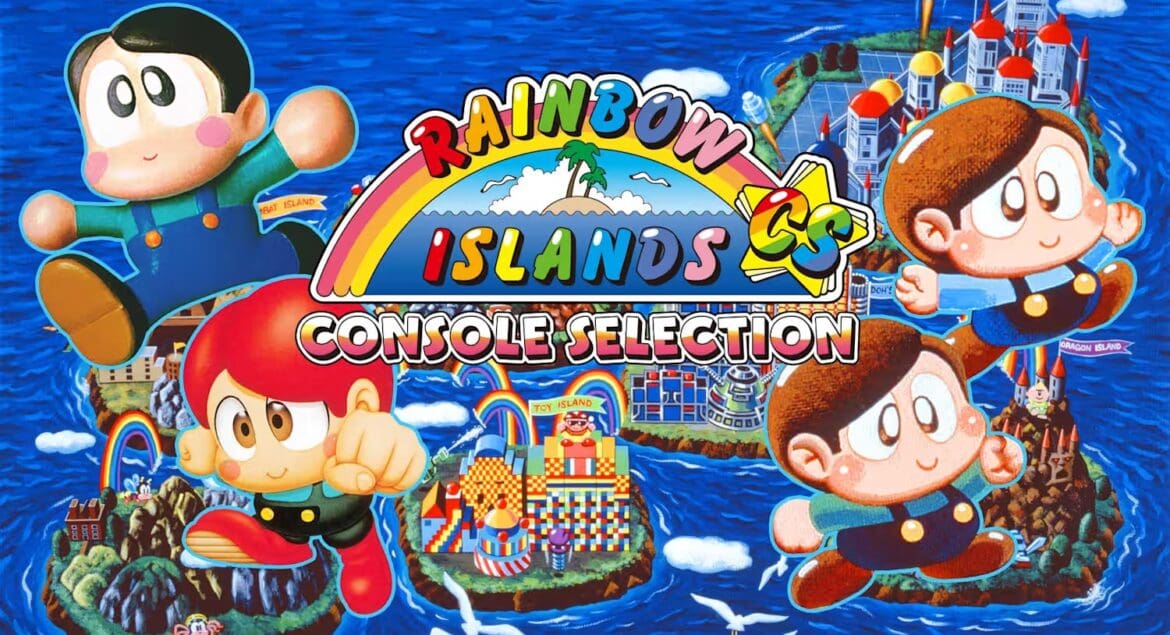
What’s this? An emulated collection containing several of the contemporary home ports of Taito’s arcade hit Rainbow Islands, originally released in 1987 as an in-name-only follow-up to Bubble Bobble; this M2-emulated pack presents the games with custom button mapping, save states, various display options, cheat/enhancement menus for each game and some additional on-screen features, including a visual guide for tracking the screen position of the all-import rainbow diamond item drops. (This collection is being released digitally worldwide, but also physically in Japan as part of a Switch physical three-pack with Parasol Stars and Spica Adventure, two vaguely-adjacent Taito action games that were reissued globally some years ago now.)
Which ports are included? This pack includes the Famicom and North American NES versions, the Sega Master System version, the Japanese Sega Mega Drive port of Rainbow Islands Extra and its Genesis localization (which was thought to be produced for release via Sega Channel, and ultimately unearthed via the Genesis Mini 2) and the PC Engine CD port; one should also note that the original main theme from the arcade version, which was present in some but not all of these ports, has been edited where necessary to conform to the legally-distinct arrangement produced for the somewhat recent Arcade Archives reissue, which itself was based on the edit present in the NES version. (The PC Engine version’s original ending theme has also been replaced with a brand-new tune from ex-Zuntata composer Norihiro Furukawa/Nakayama Raiden, on account of it being a straight-up licensed pop song.)
Why should I care? I’d be hard pressed to suggest that anyone should newly acquaint themselves via Rainbow Islands via this collection and not the authentic arcade original, as the home ports don’t offer much in the way of novel or transformative new content and are otherwise inferior, if admirable, experiences, but if you’re someone who’s specifically nostalgic for one of these versions or wants to A/B them for the sake of settling old console-war arguments, this is as solid an option as any (if you put aside the lack of Europe-borne conversions, anyhow).
Useless fact: Sharp-eared listeners might note that the edited BGM is not 1:1 across the Mega Drive and Genesis builds of Rainbow Islands Extra: the Genesis build (dated to 1994, four years after the Mega Drive release) features an authentic Zuntata-produced edit, whereas the Mega Drive version features a circa-2022 by-ear edit arranged by M2 during the production of the Genesis Mini 2, before they’d been presented with a Genesis build from which they could’ve potentially just copied the audio data.
Original article by retronauts.com