

Let’s explore two lesser-known games from a challenging year in arcade gaming.
The year 1984 was tough for the American video game industry, struggling to recover from the Video Game Crash of 1983. Atari, once the leader in arcade gaming, was split and sold off, while Florida-based Centuri exited the market to focus on fish packaging. The fierce price competition in the home computer and console market left many brands permanently relegated to the bargain bin.
Despite the setbacks, the arcade sector made cautious attempts to push onward. The days of the Pac-Man treasure may have faded, but there were still profits to be made. Gamers remained eager for new titles, prompting surviving arcade operators to adopt leaner strategies to stay afloat. Conversion kits became a popular cost-effective solution for operators wanting to introduce new games amidst the sluggish market.
Major companies like Nintendo and Sega provided these conversion kits, allowing operators to upgrade older cabinets into newer, potentially lucrative games. While dedicated cabinet titles still saw production, it wasn’t on the scale of the pre-1984 era. Smaller companies also took advantage of this opportunity, bringing previously overlooked Japanese titles to the American arcade scene through licensing—thereby establishing a lasting Japanese influence in the industry.
Taito has a rich history, one that could fill a book. Their landmark title Space Invaders was licensed to Midway for US distribution, prompting Taito to form Taito of America in 1979 to manage future releases themselves. This division was responsible for several successful titles like Qix and Zoo Keeper. After 1983, Taito scaled back their US operations but maintained a presence mainly through conversion kits.
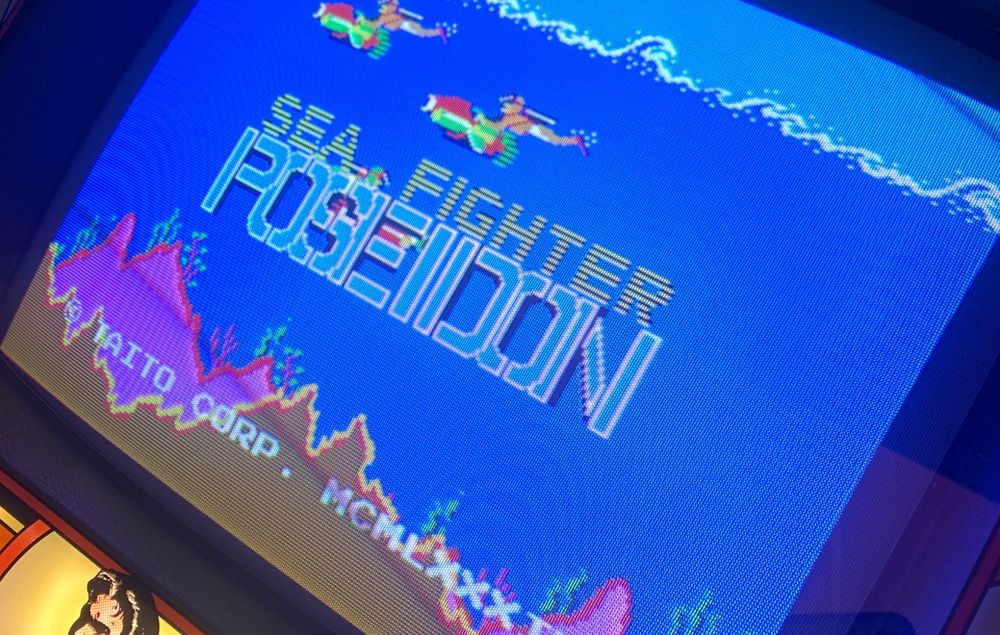
Now, let’s talk about the quirky yet enjoyable Taito game, Sea Battle Poseidon. It seems to be the last title to utilize Taito’s SJ hardware system, which also supported games like Elevator Action, Alpine Ski, and Tin Star. Many graphical and audio features from Sea Battle Poseidon echo styles seen in Jungle King/Hunt. Additionally, SJ hardware compatibility means this game can serve as a direct PCB drop-in replacement for many popular early ‘80s Taito games (it requires a cabinet with two buttons and a horizontal monitor to function).
Despite its obscurity, Sea Battle Poseidon is a fun blend of gameplay elements from Williams’ Defender, Broderbund’s Choplifter, and Taito’s own Jungle King/Hunt. At its core, it’s a side-scrolling shooter set underwater. Players control a diver operating a craft that fires missiles at enemies. The objective is to rescue kidnapped divers trapped in glass bubbles while navigating hazards and enemies.
The player’s craft burns through fuel quickly, introducing a clever gameplay mechanic: players can abandon their craft to avoid collisions or running out of fuel. If a player lands a well-timed shot on an enemy’s craft, they can take it over with a full fuel tank. However, players must be in a craft to rescue kidnapped divers or defeat certain foes. Completing a level involves rescuing all the divers and tackling challenging boss fights, navigating underwater volcanoes, sharks, and tight caverns.
Characterized by somewhat low-resolution but charming graphics and 8-bit sounds, Sea Battle Poseidon sits between gaming eras. Within a year and a half of its release, 16-bit titles like Sega’s Space Harrier and Atari’s Gauntlet would render it seem outdated. Despite its Taito heritage, it was distributed in the U.S. by the small company Montgomery Vending, which disappeared shortly after the game’s launch and seemed to have ties to the mid-’80s conversion kit champions, Magic.
The game shipped with a subpar marquee and a generic control panel overlay, leading to few kits sold. Today, it’s a rare PCB and lesser-known title, but it remains enjoyable and is available in various digital formats and classic gaming collections for home systems.
In the 1980s, ninjas and martial arts were undeniably cool. A surge of martial arts-themed films, TV shows, and arcade games took over American pop culture, and Samurai Nipponichi stands as an intriguing early entry in this genre. Released by Taito in collaboration with developer Kaneko, it deserves a look.
Established in 1980, Kaneko developed titles exclusively for Taito from 1982 to 1990, after which they branched out independently. The game was offered in the U.S. as an affordable conversion kit from a company named Magic, which soon faded from the scene. Samurai Nipponichi appears to be relatively common and not particularly sought-after, as PCBs often sell at reasonable prices (I’ve picked up two for $35 each in the past year). The appealing price of around $300-$400 for the kit, coupled with ninja craze among kids, made it attractive to arcade owners.
Samurai Nipponichi (commonly referred to as Samurai) features intriguing aspects as an early side-scrolling fighter. The graphics showcase well-designed, large sprites in a charming cartoonish style, along with smooth animation and scrolling backgrounds. The choice of using large sprites in a vertical playfield adds a unique challenge, as players must anticipate incoming enemies from off-screen. While the gameplay itself lacks depth and strategy, providing mostly straightforward enemies, the difficulty quickly escalates after the initial level.
I have two different ROM sets on my PCBs, and one seems to be slightly harder than the other. Defeating enemies sometimes results in a splatter effect of yellow blood, and the final boss meets his end via decapitation. The game never made it to any home consoles and has since faded into obscurity. Despite being overlooked, it can be forgettable due to its lackluster gameplay dynamics. The hardware for Samurai Nipponichi shares similarities with titles like Mission 660, Ring Fighter, and Nun-chackun, utilizing a dual-PCB setup for audio and video, which allows it to play without the sound board—though there would be no sound.
In summary, we’ve explored two very obscure Taito titles from the video game market’s rebound years. One is a hidden gem in my opinion, while the other has some interesting aspects but likely deserves its low profile. Both titles serve as intriguing footnotes in Taito’s legacy that any classic gaming enthusiast should explore.
Related
Original article by www.oldschoolgamermagazine.com