
Between all of the games mentioned here and the just-released Castlevania: Belmont’s Curse, I can’t imagine anyone’s in need of yet more recommendations, but this one warrants mentioning: the ver1.0 release of Ratatan, the crowdfunded successor to Sony’s handheld rhythm-strategy series Patapon that has finally made its way to consoles after years in early access. Now, I cannot with any confidence state that the game is actually finished, or delivers on the broad experience promised many years ago, but… well, I was going to say “beggars can’t be choosers”, but Sony let Namco port the Patapon games to PC and not-Sony consoles not that long ago, so even that lazy idiom no longer applies, huh?
ARCADE ARCHIVES / ARCADE ARCHIVES 2
Thundercade
- Platform: Nintendo Switch 2, PlayStation 5, Xbox Series S/X (worldwide, ACA2) / Nintendo Switch, PlayStation 4 (worldwide, ACA)
- Price: $9.99 / €8.99 / £7.39 (ACA2), $7.99 / €6.99 / £6.29 (ACA), $2.99 / €2.99 / £2.49 (ACA-to-ACA2 upgrade)
- Publisher: Hamster / Seta
What’s this? An vertically-scrolling military-themed shooting game, originally developed by Seta and distributed in arcades by Taito in 1987, with a home conversion developed by Micronics and published by Sammy exclusively for the NES in North America in 1989; one or two players take their fight to the enemy via a military-grade motorcycle, which can be equipped with sidecar armaments that fire in various directions and can be discovered inside buildings or any of the other many destructible objects present across the game’s four environments.
Why should I care? You want to A/B the original with the NES port and confirm for yourself that Micronics’ port was actually… okay? (It’s also worth acknowledging this release as the Arcade Archives debut from the catalog of Seta, a company known globally for games like Cal.50 and Twin Eagle and known in Japan for the Super Real Mahjong series; that said, SRM is owned separately from the larger Seta catalog, so even putting aside any content concerns, don’t expect to see those particular games on Arcade Archives anytime soon.)
Helpful tip: Thundercade has a very aggressive on-screen shot count limiter which has a significant effect on the efficacy of playing with rapid-fire, so be sure to consult the manual for recommended rapid-fire speeds & situational uses.
Stinger
- Platform: Nintendo Switch 2, PlayStation 5, Xbox, PC via Xbox Play Anywhere (worldwide, ACA2)
- Price: $9.99 / €8.99 / £7.39 (ACA2), $2.99 / €2.99 / £2.49 (ACA-to-ACA2 upgrade)
- Publisher: Hamster / Seibu Kaihatsu
What’s this? A vertically-oriented, horizontally-scrolling sci-fi shooting game, developed by Seibu Kaihatsu (then known as Seibu Denshi) and distributed in arcades by Sigma in 1983, and reissued via Arcade Archives last year; in addition to destroying enemies with the standard shot and deployable “Bongo” homing option, the player is also tasked with refueling their ship by hovering above the crab-like fuel stations that appear on the grounded portions of each stage. (This game is not to be confused with the NES game Stinger, which is in fact a US-localized version of Konami’s Moero Twinbee.)
Why should I care? The pseudo-3D perspective used for the backgrounds is very well-crafted for an early-’80s game, and you might simply be curious to try Seibu’s first shooting game, developed long before their mega-hit Raiden.
Useless fact: Seibu would later reuse the Stinger title for early location-test versions of the game that would ultimately release as Raiden Fighters.
CONSOLE ARCHIVES
THE DRUG STORE (PlayStation)
- Platform: Nintendo Switch 2, PlayStation 5 (worldwide)
- Price: $11.99 / €10.99 / £9.89
- Publisher: Hamster / Human Entertainment
What’s this? A spinoff of the Human-ported and published The Conveni series of compact retail business sims, originally published for Sony PlayStation in Japan in 1998 and later reissued in the ’00s as part of Hamster’s Major Wave budget line; players work to run and expand their chain of drugstores by strategically devising the location and layout of their premises, tailoring their stock to the preferences of their regular customers and more. (As is typical of Console Archives, this game’s being presented in its original Japanese with no overtures towards localization.)
Why should I care? I have not played this game but near as I can tell, it’s basically just The Conveni 2 with a very slight veneer on it, so if you have a hankering for more of that particular entry, here ya go.
Useless fact: The original version of this game was released as a branded tie-in to real-world drugstore chain Matsumoto Kiyoshi, but Hamster stripped out all the branding when they put out the Major Wave version, and that unbranded version is what’s being served up again here.
EGG CONSOLE
The Screamer (PC-8801)
- Platform: Nintendo Switch (worldwide)
- Price: $6.49 / ¥770
- Publisher: D4 Enterprise / Magical Zoo
What’s this? A dungeon-crawling action-RPG with a post-apocalyptic vibe, originally developed and published (inside a hollowed-out book, no less) by Magical Zoo for PC-88, PC-98 and Sharp X1 in 1985. Players guide bounty hunters called “Screamers” on a mission to investigate and eradicate the mutated creatures spawning from the abandoned research facility BIAS, a GMO laboratory intended to solve a global hunger crisis that has been corrupted by the radioactive fallout of world war; in addition to DEHUMANIZ(ING) YOUR SELF AND FACE TO BLOODSHED, one is tasked with healing, equipping and recruiting party members from the central town, exploring the BIAS-facility via first-person, grid-based exploration, engaging in simple, real-time side-view combat with various beasts and returning to town in order to cash in for currency and experience… or, if you’re unlucky, you’ll die and the game will forcibly delete your save data. (This reissue also includes scans of the included manga, drawn by the recently-departed Showhei Halumoto, who doubled as the game’s character designer/illustrator.)
Why should I care? You understand that you have an obligation to try a game that indirectly given so, so much to so many people, and you accept that the game’s combat, which in most other contexts would present as a glaring flaw due to being overly basic and unengaging, might actually work in the game’s favor by allowing more people to experience the game’s gnarly wasteland-cyberpunk vibes without being stymied by the unrelenting difficulty that typified other comparable dungeon crawlers of the day. (I should also reiterate that EGG’s reissues include save state functionality, so you needn’t concern yourself with permadeath.)
Language barrier? Most of the game’s English text resides in the forever-referenced intro splash: beyond that, most everything is rendered in katakana/hiragana, and while it certainly doesn’t present as many potential roadblocks as some other comparable games, you’re probably going to get tripped up here and there (particularly at the very beginning) if you can’t read any of the text.
G-MODE ARCHIVES+
- Platform: Nintendo Switch (Japan)
- Price: ¥800
- Publisher: G-MODE / Bandai-Namco
What’s this? A turn-based fantasy RPG, originally distributed on Japanese feature phones in 2010 by Bandai-Namco as a successor to the original 2008 game Lost Chronicle, which was reissued via G-MODE Archives a few months back; this game presents as a conventional but significantly more voluminous follow-up to the original, with slightly improved audiovisuals and a massive increase in story, main and post-game quests, enemies, job classes and skills and items to acquire and/or synthesize, as well as character designs and digitized illustrations by Anji Majima, primary designer for Square-Enix’s Lords of Vermillion/Arcana.
Why should I care? While I cannot confirm that any of the content is necessarily any more thoughtfully designed than this era’s usual assortment of overly-grindy time-wastery, this game made waves in its day for simply giving players so much more to do than comparable mobile RPGs, so anyone who picks this up should at least receive bang for their yen, if nothing else.
Helpful tip: You’ll be able to grab this game on Steam in two weeks.
NINTENDO SWITCH ONLINE EXPANSION PASS
October ’26 update: Kururin Paradise, Metal Slug Advance and Monster Rancher Advance (Game Boy Advance)
What’re these? The first handheld entry in Tecmo’s series of monster-breeding games, an original handheld Metal Slug game with a more bite-sized, exploratory format and the first-ever global release for the Japan-only sequel to the cult Nintendo-published irritating-stick maze action game Kuru Kuru Kururin.
Why should I care? Egregious palette-swapping aside, Monster Rancher Advance really does capture the core horse-sim-meets-Pokemon loop of the console entries, so if you try and enjoy this version, know that you can only go up from here; as for Metal Slug, I suspect the process of repeatedly playing stages in order to find and secure all the collectible upgrade cards is probably better-suited to a lot of players than the traditional full-fat arcade games, credit-feeding or no. Kururin Paradise is a game so simple that one would be best served by just going hands-on for thirty seconds: if you’ve never played it, know that it’s exactly as straightforward as it seems, and if you’re coming from the original, trust that it’s a very worthy and very assured sequel, with the main point of differentiation being the (mostly not-terrible) minigames that punctuate the end of each world.
Helpful tip: Monster Rancher Advance substitutes the console games’ famous CD-swapping monster-generation system with a system based on alphanumeric passwords and, as I’m sure you can imagine, there are zillions of circa-2002 websites and walkthroughs out there will all the passwords you might possibly require.
OTHER
Moto X (October 16)
- Platform: PlayStation 5, PlayStation 4, Xbox, Nintendo Switch (worldwide)
- Price: $5.99 or equivalent
- Publisher:Ratalaika Games
What’s this? The official emulated commercial debut of Moto-X, a side-view motocross racing game for Super Nintendo that was originally developed by Software Creations in 1994 but ultimately went unreleased until its acquisition and homebrew cartridge release by Piko Interactive in 2023; this version’s presented with Ratalaika’s usual trimmings, which include save states, rewind, various controller configs, screen options and more.
Why should I care? Piko’s reputation for happily commercializing games that were blatantly unfinished or just plain unfun is not undeserved, but Moto-X is an outlier inasmuch as it’s a complete game that competently delivers on being a slightly-less-simple Excitebite.
Useless fact: The guitar samples featured in this game’s music are straight out of Plok.
Resident Evil 2, Resident Evil 3 & Resident Evil 4 (remakes)
- Platform: Nintendo Switch 2 (worldwide)
- Price: $29.99 or equivalent (RE3), $39.99 or equivalent (RE2), $49.99 or equivalent (RE4)
- Publisher: Capcom
What’re these? Native Switch 2 ports of the recent trilogy of Resident Evil remakes, following the cloud-only versions released for the original Switch; aside from RE2/RE4’s inclusion of previously-released DLC (and RE3 missing the multiplayer sub-game), you’re getting very straightforward ports of the games as seen on PS4/5/XB/PC a few years ago.
Why should I care? My understanding is that being released near or around Halloween is all any horror game needs to find an audience, but things can’t be that simple can they? (For those gyro-aiming diehards, know that RE2/3 are completely lacking in gyro support, and RE4′s gyro support is said to be quite shoddy. No joycon mouse functionality, either, in case anyone was expecting that.)
Helpful tip: These games are getting physical releases in early January (via game key card, I believe).
- Platform: PlayStation 5, PlayStation 4, Nintendo Switch 2, Nintendo Switch, Xbox, PC via Steam (worldwide)
- Price: $39.99 or equivalent
- Publisher: Bandai-Namco
What’s this? A remaster of the third mainline game in Namco’s long-running Tales of… series of anime-inspired action-RPGs, originally developed and published for Sony PlayStation in Japan in 2000 and North America in 2001 (under the title Tales of Destiny II), and later ported to and published for PlayStation Portable in Japan in 2005 and worldwide in 2006; this remaster is based on the PSP version and has been reconfigured for widescreen dsplays, offering the option to switch between filtered or untouched visuals, a revised localization, upscaled animated cutscenes, convenient features like quest/objective markers, the ability to disable random encounters, new difficulty modes, the ability to skip cutscenes and more.
Why should I care? You’re excited to see Namco’s Tales remaster initiative finally reach back into the 2D era and you want to experience or revisit a game identified my many as a favorite among the early games, and you’re permissive of the updated localization not necessarily modernizing any of the voice acting.
Overly-hopeful speculation: One of the achievement descriptions explicitly mentions Tales of Phantasia in a manner that one could interpret as a hint that it’ll be officially available at some point in the not-too-distant future…
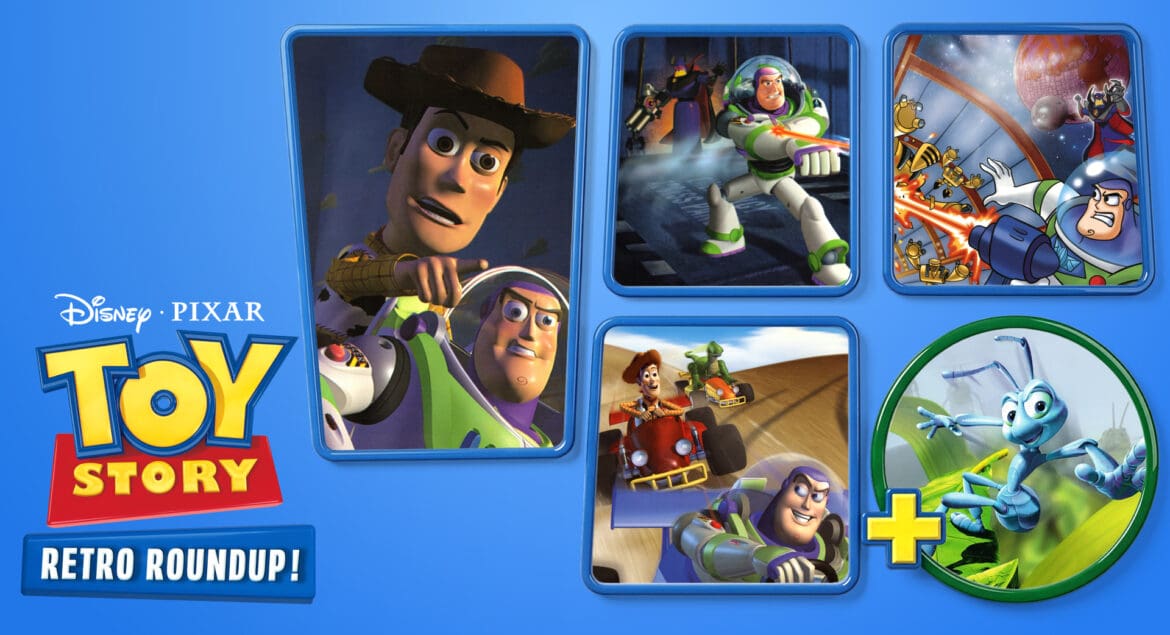
Toy Story: Retro Roundup! & Toy Story 3 Complete Edition
- Platform: PlayStation 5, PlayStation 4, Nintendo Switch 2, Nintendo Switch, Xbox, PC via Steam (worldwide)
- Price: $29.99 or equivalent (each), $39.99 or equivalent (double-pack)
- Publisher: Disney / Atari / Digital Eclipse
What’re these? An emulated collection of console and handheld games produced around the Pixar’s first two Toy Story films (spanning 1995 to 2001) and a port of the high-definition tie-in game to 2010’s Toy Story 3, respectively; Retro Roundup! comes with Digital Eclipse’s signature treatment (rewind, save states, various screen options, art and music galleries and documentary-style video features with developers and producers), whereas Toy Story 3 is a fairly straightforward port that boasts up to 60FPS/4K resolution and the inclusion of content that was previously exclusive to the PlayStation 3 version. (Do also note that the physical release is a double-pack that includes both the collection and the Toy Story 3 port.)
Which games are included? Retro Roundup! includes the Sega Genesis, Super Nintendo and Game Boy versions ot Toy Story, the PlayStation version of Toy Story 2: Buzz Lightyear to the Rescue, the Game Boy Color version of Toy Story 2, the PlayStation and Game Boy Color versions of Toy Story Racer, the PlayStation and Game Boy Color versions of Buzz Lightyear of Star Command and, for no particular reason, the PlayStation and Game Boy Color tie-ins to the Pixar film A Bug’s Life!
Why should I care? Of the many licensed games and compilations released over the last several years, the games presented here (or at least, the games directly tied to the three movies; the others are shakier) might represent the most credible and least nostalgia-reliant of the bunch — whether by luck or by design, Disney so happened to assign these games to very competent and technically proficient designers who were able to not only express the characters and tone of the films and the cutting-edge nature of the visuals but also provide experiences with a little more substance than not at all.
Helpful(?) tip: Leading up to these releases, Disney saw fit to delist several existing reissues of these games, including the Xbox 360 version of Toy Story 3, the PS Classics version of Toy Story 2 and the PlayStation Portable version of Toy Story 3 (which isn’t even covered by either re-release!). “Preservation”, eh?
- Platform: Nintendo Switch (worldwide)
- Price: $9.99 or equivalent
- Publisher: Com2us
What’s this? A Switch port of the recent PC remaster of the first entry in Korean developer Gamevil’s popular mobile phone action-RPG series Zenonia, which hit pre-smartphones in 2008 and migrated to iOS, Android, PlayStation Portable, Nintendo’s DSiWare service and even Zeebo; this version largely maintains the look and mechanics of the original, with changes centered around adapting and modernizing the controls and UI for modern setups.
Why should I care? You have atypically fuzzy memories towards the absolutely grueling grind presented by this game and others of its ilk, which were once primarily and almost stereotypically associated with Korean-borne games and which some would argue are harder to justify to modern audiences than the five-frames-a-second, three-kilobites-big flip phones games people used to placate themselves just a year or two before Zenonia was hot.
Useless fact: A Zenonia 2 remaster’s already in the works, and may be out before the end of the year.
DISCOUNTS & DEALS
EGG Console Falcom sale (Nintendo Switch; ends November 9)
The discount’s slight, but EGG’s offering deals on a half-dozen Falcom classics, including the original Ys, the first two Dragon Slayer: The Legend of Heroes titles, the ultra-brutal Xanadu: Scenario 2, the cinematic shooting adventure Star Trader and — of particular note to many, I’m sure — the original PC-88 version of Popful Mail.
Original article by retronauts.com