
-

Amiga 1200 – holographic Boing ball
Amiga 1200 – holographic Boing ball. Printed on high quality silver vinyl (holographic) and finished with epoxy gel.
€4,25 -

Amiga 1200 – holographic Checker
Amiga 1200 – holographic Checker. Printed on high quality silver vinyl (holographic) and finished with epoxy gel.
€4,25 -
-
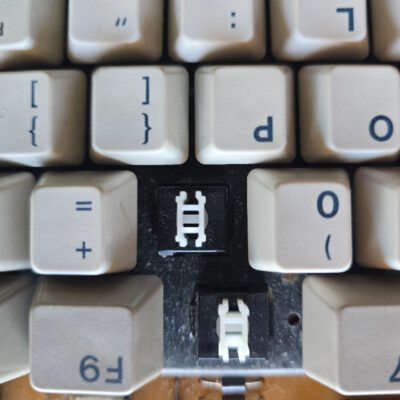
Amiga 1000 keycap
A very hard to find keycap, from original Amiga 1000 keyboards. Please state which one you need. We can’t guarantee we have them all, but if not, we will refund. Or send us an email first… Price is per key with mechanism included.
€19,95Amiga 1000 keycap
€19,95 -
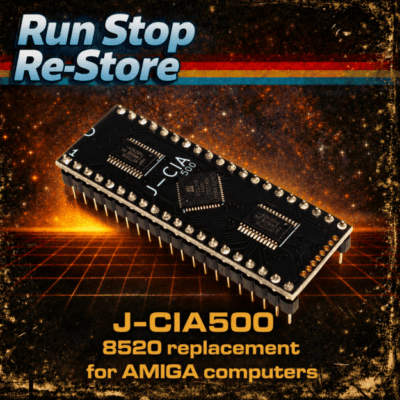
J-CIA500 8520 Replacement for AMIGA and 157x/1581 diskdrives.
Now shipping!
Developed by Jani, distributed by Retro8bitshop!
A modern FPGA-based replacement chip for the Commodore Amiga 500, Amiga 1000, Amiga 2000, Amiga 3000, and CDTV computers. Also compatible with the Commodore 1581, 1570, and 1571 disk drives.Main features and specifications:
- FPGA based replacement for the MOS/CSG 8520CIA chip in DIP40 format.
- Complete logic and all features of the original IC implemented
- All common AMIGA diagnostic & software such as DiagRom and AMIGA Test Kit passed 100%.
- Hundreds of demos and games already tested with no known compatibility issues.
- Physically about the same size as the original CIA, and drops right in place of the original chip without any mainboard modifications or soldering required.
- Tested with all relevant AMIGA Pre-AGA era mainboards suchs as A500, A1000, A2000, A3000, CDTV, and the 1570/1571 & 1581 Diskdrives.
- Tested in combination with many different peripherals, accelerators and expansions.
For EU customers, price listed includes applicable VAT rate
€39,95 -
-
-
Motorola MC68EC060RC66 processor
A working & tested holy grail of 060 cpu’s
€395,00Motorola MC68EC060RC66 processor
€395,00 -
Amiga Ornaments Mical/Haynie
Fit the slots in A500/A600/A1200 and comes with adapters to use them as floppy disk stands.
€4,95





The Amiga is a family of personal computers introduced by Commodore in 1985. The original model was part of a wave of 16- and 32-bit computers that featured 256 KB or more of RAM, mouse-based GUIs, and significantly improved graphics and audio over 8-bit systems.