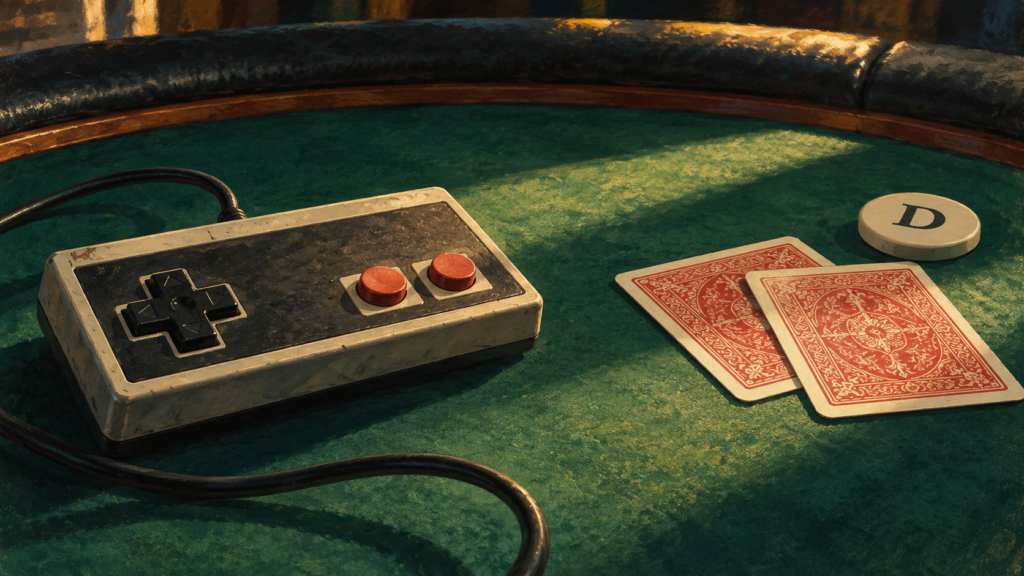
Up, Up, Down, Down, Left, Right, Left, Right, B, A. If that sequence still comes back without a moment’s thought, you probably remember its appeal: a brutal game suddenly gave you room to breathe. Poker has nothing that adds 30 lives or upgrades the cards in your hand. Its closest equivalent is knowing what to do before a hand gets complicated. Two habits help: choosing your starting hands carefully, and paying attention to who acts after you.
The Konami Code first appeared in the Famicom version of Gradius, released in Japan on April 25, 1986. Enter it while the game was paused, and the ship received most of its available upgrades. Contra gave the sequence a different job on the NES in 1988, increasing the starting lives from three to 30. Either way, the attraction was immediate. A few familiar inputs changed what you had to work with.
Poker asks you to start with less certainty. On Ignition Poker, anonymous tables replace user IDs with numbers, so there is no familiar screen name to connect with a regular opponent’s history. You can still observe how someone plays during the session. On the first hand, though, the useful questions are already there: what are your two cards, who has raised, and how many players can act after you? You don’t need a detailed read on anyone to ask them. They give you a reason to play or fold before the flop – the first three shared cards – creates a whole new set of decisions.
Why acting last matters
The video below puts position and starting hands first in its ten-part guide, with “Position is Power” at 0:35 and “Play Tighter Starting Hands” at 1:05. Those two ideas belong together. A hand’s value depends partly on whether you will have to make decisions before your opponents reveal anything through their actions.
Start with the dealer button, the marker that determines the order of play. It moves clockwise around the table between hands. At a six-player table, the two seats immediately after it post the small and big blinds, the forced bets that begin the pot.
Before the flop, the player immediately after the big blind acts first. The big blind gets the sixth turn on that first pass, although a raise can send the action around again. Once the flop arrives, betting starts with the first remaining player clockwise from the button. The button acts after the other players if still in the hand. The same order applies on the turn and river, the fourth and fifth shared cards.
That difference is easy to feel in a hand. Suppose you reach the flop on the button, and both remaining opponents check, passing without betting. You can check too and see the turn without another bet that round. Act first, and you cannot make that decision for everyone: someone behind you may bet. Position gives you information and, sometimes, a choice you would not otherwise have. A check does not prove weakness, but seeing it beats having to guess whether it is coming.
Watch a few complete hands after folding and follow the action from the first player to the button. You can see the information accumulating, even without knowing anyone’s cards. That makes position easier to grasp than memorizing seat names.
An ace isn’t enough on its own
Starting hands deserve the same attention. An ace beside a small card can look inviting, especially after several folds. The difficulty often begins when it catches exactly the card you wanted.
Suppose you hold an ace and a six of different suits. The flop brings an ace, a nine, and a two, all in different suits. You have a pair of aces. An opponent holding ace-queen has a better pair of aces because the queen, their kicker, outranks your side card. You improved, but you are still behind.
The awkward part is that the flop looks reassuring. Folding before it arrived was one decision; now you have a pair and may face bets on three streets. A starting-hand choice has become a series of harder judgments about how much strength the other player is showing.
Playing fewer marginal hands reduces how often you enter situations like that. It also explains why starting-hand advice changes with position. From an early seat, several players can still raise after you. If everyone folds to the button, only the blinds remain, and you will act after them on later betting rounds. That can justify playing a wider selection of hands. An earlier raise changes the decision again.
Give the later decisions a better start
The video’s remaining chapters cover aggression, value betting, reading the board, recognizing stronger hands, and understanding opponents. Those skills still matter. Position helps you apply them with more information, while hand selection changes the situations in which you need them.
Gradius developer Kazuhisa Hashimoto created the Konami Code because the game was too difficult during testing. It gave him a more manageable starting point. You can do the same with poker, not via cheat codes, but through a solid understanding of the game and why certain crucial elements deserve your attention.
Poker never promises the same outcome from the same inputs. A strong hand can lose, and a sensible fold can be followed by cards you wish you had seen. The useful habit is to judge the decision from what you knew when you made it. Before looking for a clever play on the river, check how you entered the hand: your cards, your position, and the action ahead of you.
Related
Original article by www.oldschoolgamermagazine.com